What LLM Agent Frameworks Actually Add
A practical introduction to agent workflows, using a CrewAI newsroom example to explain roles, loops, and trade-offs.

An LLM becomes more useful in a workflow when it has a defined job, useful tools, and a way to check its work.
What an agent workflow is
An LLM agent does more than answer one prompt. In an agent workflow, the model can decide which step to take, use a tool, pass work to another step, and continue until the task reaches a stopping condition.
The framework provides structure around that loop. It can manage roles, state, tool calls, retries, and the handoff between stages.
The building blocks
There are several common patterns:
- Specialized roles let one agent research while another drafts or reviews.
- Tool use lets an agent search sources, call an API, or read a file.
- Workflow state lets later steps use earlier output and decisions.
- Checks and loops let a reviewer send weak work back for another attempt.
These patterns are useful because a large task becomes a series of smaller decisions. They do not remove the need for good prompts, sensible limits, or human review.
Example: a small AI newsroom
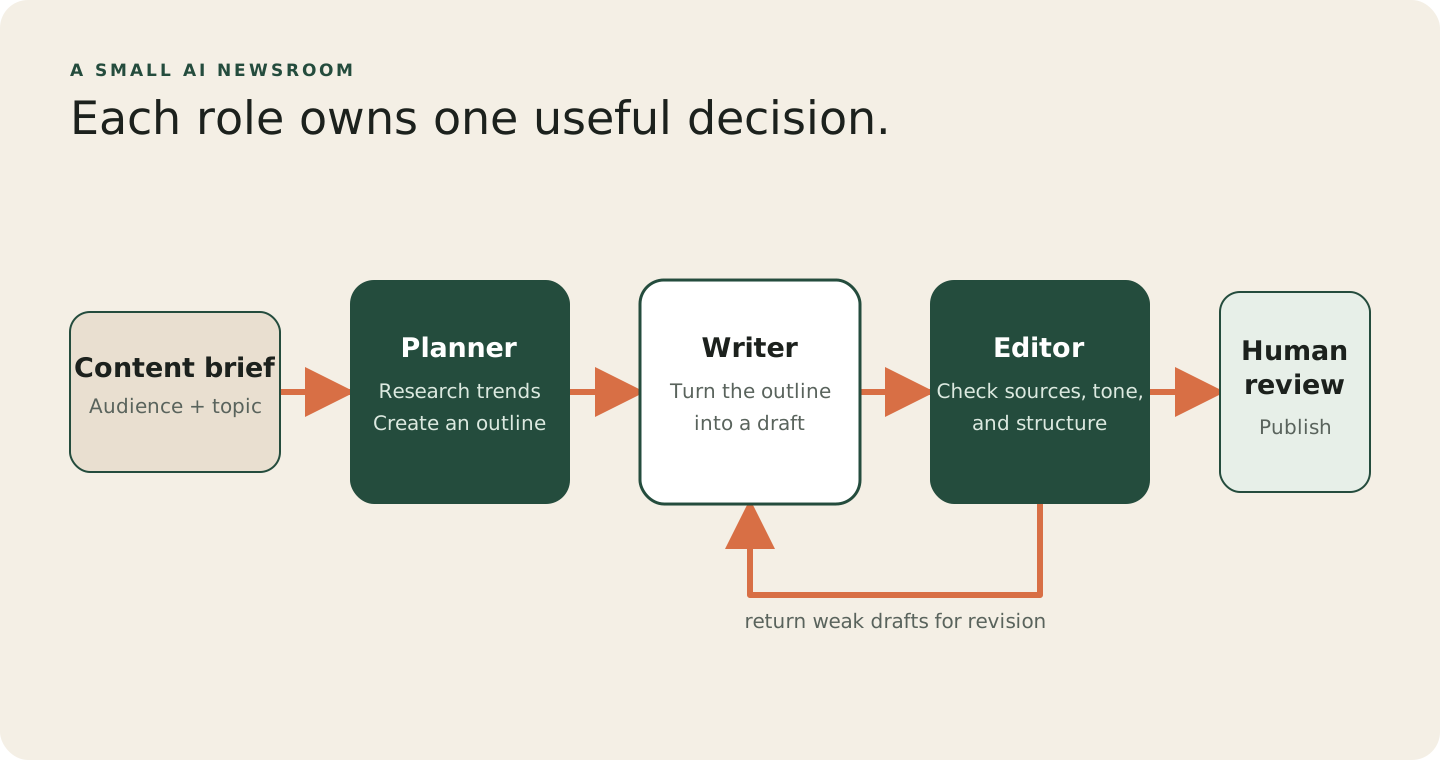
For a marketing team creating an article about AI automation, I would split the work into three roles.
The Content Planner searches for trends, key players, and relevant terms, then creates an outline for the target audience.
The Content Writer turns the outline into a draft with an introduction, supporting details, and a clear conclusion.
The Editor checks the draft for factual support, grammar, tone, and structure. A person still reviews the result, while the workflow handles the repetitive coordination.
Example: a blog post about BLACKPINK’s Jennie created by the AI crew
Choosing a framework
The best framework depends on how much control the workflow needs.
CrewAI is convenient for role-based experiments. It makes it easy to describe a team of agents and connect their tasks.
LangGraph is useful when the workflow needs explicit nodes, edges, state, and conditional loops. That control becomes valuable as the system grows.
AutoGen is designed for flexible conversations among agents and can be a good fit for research prototypes that need open-ended collaboration.
These are starting points. The right choice depends on whether your priority is quick experimentation, explicit control, or flexible interaction.
Lessons from using the pattern
I used CrewAI to generate an early version of this article with Planner, Writer, and Editor roles. The draft was useful, but it still needed human editing.
That experience reminded me that an agent framework can organize work, but it does not guarantee correct facts, good judgment, or a publication-ready result.
Conclusion
Agent frameworks are most useful when they make a complex workflow easier to see and control.
I would start with the smallest sequence of steps that solves the problem. Add tools only when needed, and keep a human review point where mistakes matter.