Building a Weekly AI Digest with an Agentic Workflow
I built a small AI newsroom with CrewAI to collect, filter, and summarize the AI news I actually want to read.

I wanted to keep up with AI news without turning every week into a long session of opening tabs.
After building an LLM workflow to classify email, I wondered whether I could use the same idea for industry news. The goal was simple: collect recent items, remove noise, summarize the useful ones, and send myself a readable digest.
The idea
I read blogs and newsletters about AI, but quantity quickly becomes a problem. I did not want a system that collected everything. I wanted one that filtered the list according to my interests.
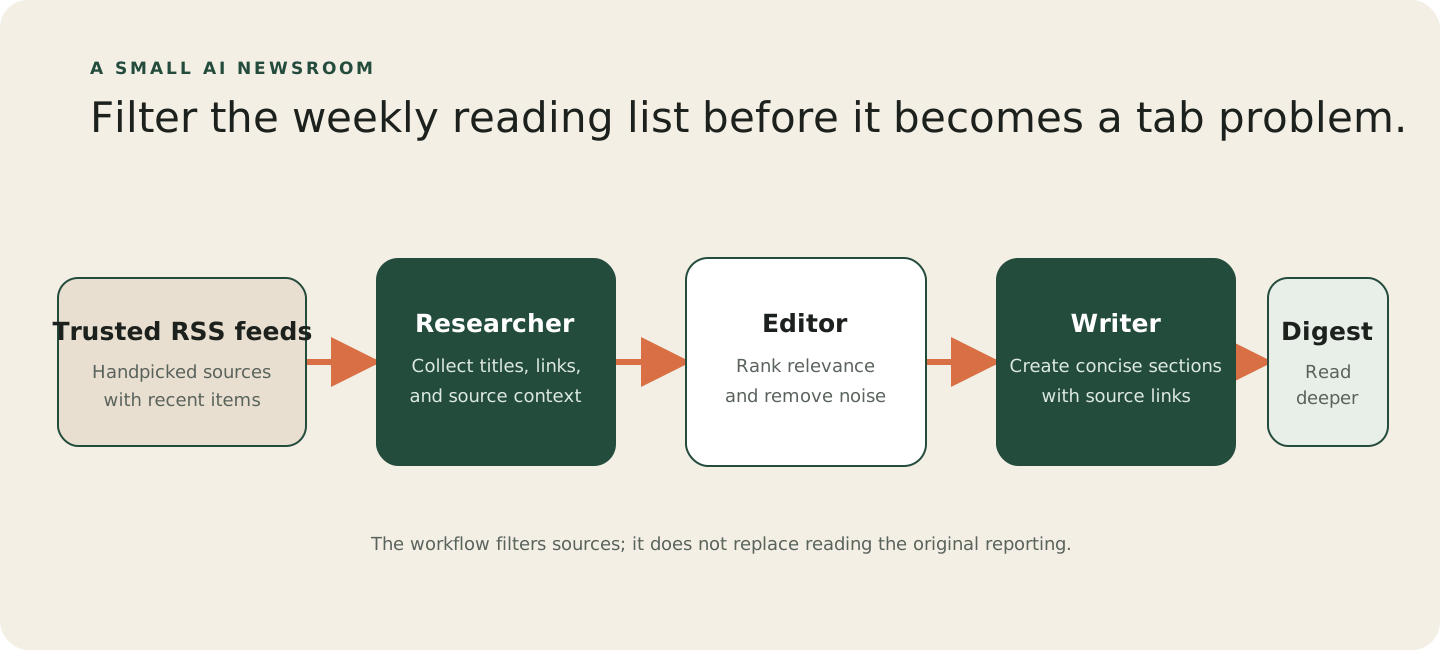
Instead of putting every step into one large prompt, I used a small agentic workflow. It behaves like a newsroom with separate research, editorial, and writing roles.
The three roles
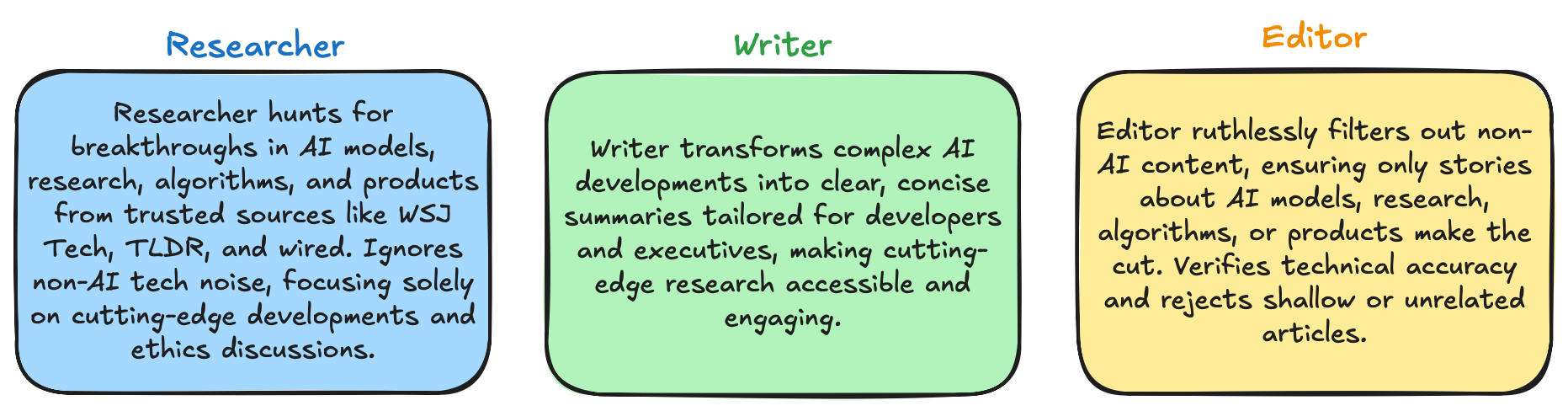
This division makes the workflow easier to adjust. I can change the source list without rewriting the writer, or change the ranking criteria without changing how summaries are formatted.
Keeping low-quality sources out
The internet contains more AI-generated content than I want to read. I therefore started with a small, handpicked list of RSS feeds.
This is not a perfect quality filter. It is a practical boundary that keeps the researcher from searching the entire web and returning a pile of content I would not trust.
How the workflow runs
CrewAI coordinates the roles. The Researcher collects articles, the Editor chooses what is worth keeping, and the Writer produces the digest.
The first test already gave me a useful list. It was not perfect, but it made it easier to decide which stories deserved a deeper read.
What still needs work
The content was more useful than the presentation. I wanted clear sections, short bullet points, and a consistent link for every item.
I focused next on a better output format for the Writer, with clear sections, short bullet points, and a consistent link for every item.
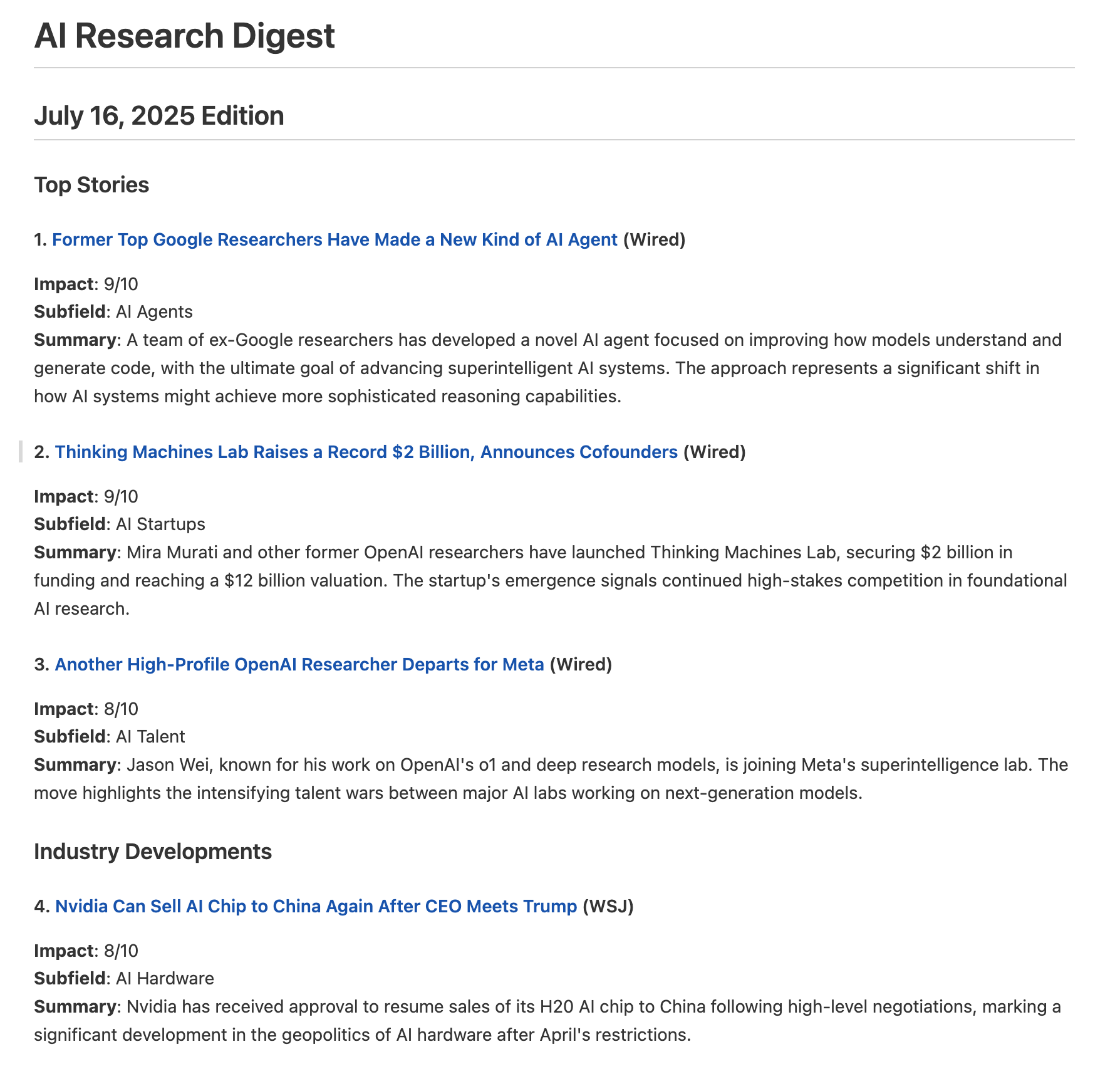 Current digest output.
The result
The workflow saves time by removing the first round of scrolling and sorting. It is also easy to customize: add an RSS feed, change the relevance rules, or change the summary format.
I still read the source material. The workflow is a filter that helps me decide where to spend my attention.